Commercial Audit
For service pages, city pages and listings. See what the buyer checks before ordering, whether your page answers it with something concrete, and which of your claims have proof next to them — the evidence that reads as expertise to Google and to AI answers.
Compare against specific pages instead of the live top
What the buyer checks — and whether you answer it
Timeline, pricing model, who does the work, deliverables — each marked must-have, optional or nobody-has-it against the top 5, with a check whether your answer is concrete (a number, a format, a name) or just words.
Where the page stops selling
Paragraph by paragraph, see where a service page drifts into an article. Strike paragraphs out and watch the balance move — no rewrites pushed, no credits spent.
Which claims have proof next to them
"Expert", "leading", "15 years" are claims. We list the ones with nothing backing them on the page — no case, number, name or date. Proof is what reads as expertise to Google and to AI answers.
Your report
Two coordinate systems on one page. The buyer tree lists what someone evaluates before ordering — timeline, deliverables, pricing model, who does the work, platform segments. The SERP shows what the top already says. Where they agree it's a must-have; what only the SERP repeats is optional consensus; what neither covers is your whitespace. Concreteness is checked per branch: tools, formats, numbers — present or not. No density, no score.
Every "expert", "leading", "years of experience" is a claim. We look for a passage on the same page that actually entails it — a case with numbers, a named process, a date. Unsupported claims are listed, not scored. Alongside: whether your team has names and roles, whether the page carries time markers, and whether the first screen states the offer, a price anchor, a fact and an action.
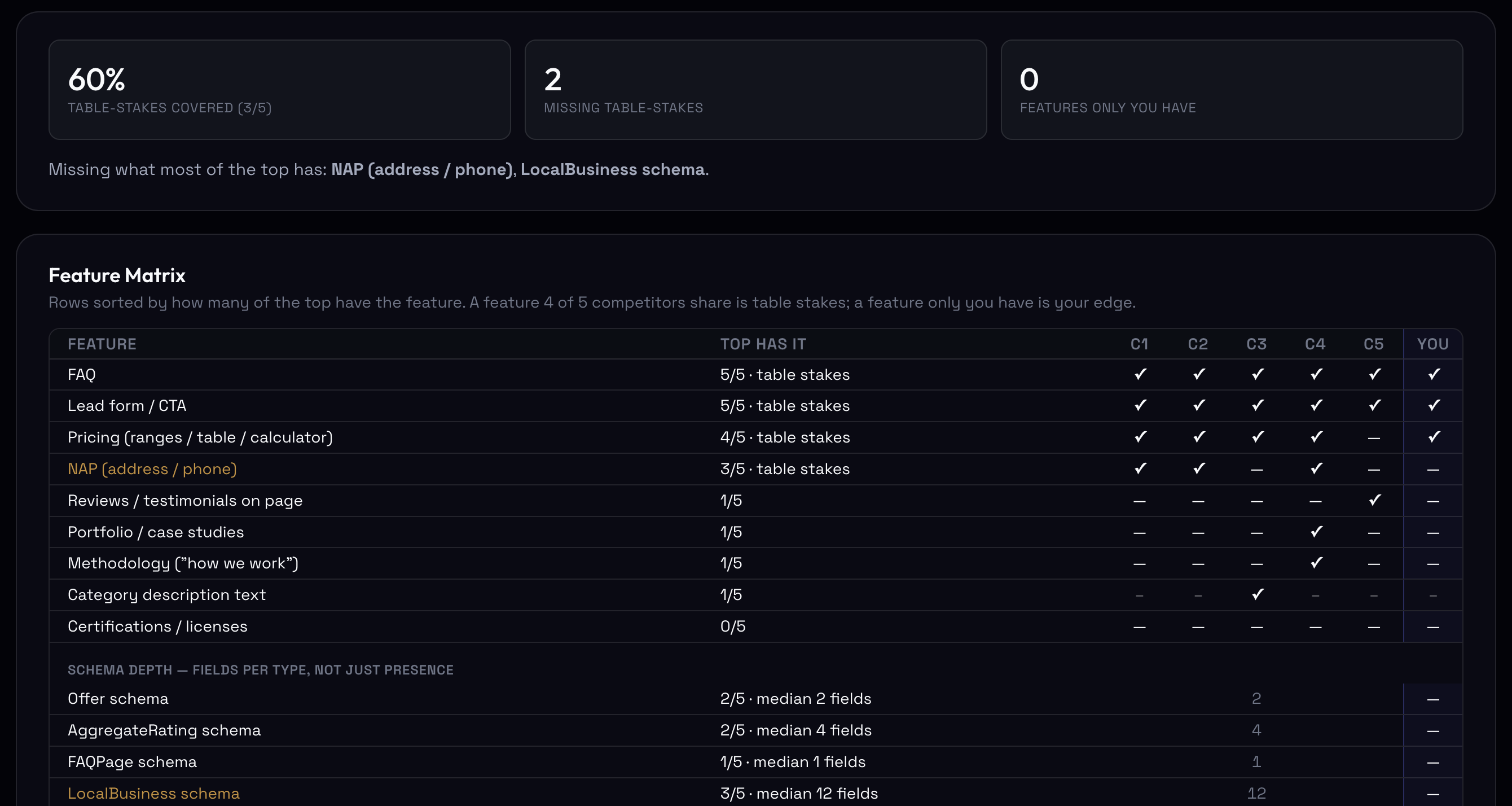
No worse on the table: blocks, schema depth, card attributes — each weighted by how many of the ranking pages have it. This used to be the whole report; now it's the floor, not the goal.
Rows sorted by how many of the top have the feature. A feature 4 of 5 competitors share is table stakes; a feature only you have is your edge.
Is your page inside the semantic field of this SERP? Zones are calibrated on the top's own passages — never fixed thresholds.
This tool measures your page. For the local pack, most of the weight sits off the page — and for AI answers the balance flips back toward on-page. Both columns below are survey weights, not our invention.
Local Pack / Maps
AI Overviews / AI Mode visibility
For being cited in AI answers, on-page rises to the top slot — the work this audit points at weighs roughly twice what it does in Maps.
See it in action