Open the marketing page of any keyword research tool and you'll see a number. Twenty-five billion keywords. Forty billion. Whatever's bigger this quarter. What you won't see is where those keywords come from. Spoiler: it's the same place in every tool.
I've used most of them — Semrush, Ahrefs, Mangools, Keyword Planner, the lot. Different interfaces, different filters, different difficulty scores. Same source. They all scrape Google Suggest at scale, layer in clickstream estimates, and sell access to the resulting dictionary.
That worked when search meant Google. It doesn't anymore. The gap between what these tools cover and where buyers actually type queries is what this article is about.
Why one source stopped being enough
Search broke into pieces somewhere between 2022 and 2024, and most SEO workflows haven't caught up.
In 2022, Google's senior VP Prabhakar Raghavan said publicly at a conference that around 40% of Gen Z users go to TikTok or Instagram instead of Google when they need to find something — restaurants in his example, but the pattern generalises. That was three years ago, and it's only accelerated since. Then in February 2024, Google paid Reddit roughly $60 million a year to license its content for AI training. After that deal, Reddit visibility in Google's own results jumped — anyone tracking "best X" queries watched Reddit threads displace traditional SEO content across hundreds of categories within months. Then ChatGPT and Perplexity started taking real chunks of informational search traffic, with their own query patterns that look nothing like Google searches.
None of this is news. What's odd is that most keyword research workflows still start and end with Google data, as if those three things hadn't happened.
A query like "best running shoes for plantar fasciitis" exists in every Google-based keyword tool. A query like "running shoes that don't kill my feet recommendations" — which is closer to how a real person types into Reddit — exists in approximately none of them. Both queries indicate intent to buy. One is in your tool. One is where the buyer is.
The myth of the keyword database
The "database" framing is the part that misleads people most. When a tool advertises 25 billion keywords, that doesn't mean it has 25 billion validated, demand-ranked search queries. It means a crawler typed plausible 2-3 word combinations into Google Suggest and saved whatever came back. That's the database. It's a frozen scrape of one autocomplete API.
Three things follow.
First, every Google-based tool sees roughly the same keywords. The differences are around the edges — sampling cadence, filters, volume estimation methods. The list itself is interchangeable between Semrush, Ahrefs, and Keyword Planner. If you've ever wondered why pulling a seed keyword from two different tools gives you 90% the same expansions, that's why.
Second, "keyword difficulty" is mostly fiction. The score these tools sell as KD or Difficulty is calculated from backlink counts of currently ranking pages. That metric correlated reasonably well with actual ranking effort in 2017. Today, with Helpful Content updates, AI Overviews, and topic-level authority weighting, it correlates with very little. The score looks precise — KD: 47 — but the precision is decoration.
Third, and this is the one that matters: queries that don't go through Google never enter the database. TikTok searches, Amazon searches, Reddit threads, Etsy queries, Perplexity prompts — none of that is in any tool that scrapes Google Suggest. By definition.
Where people actually search now
Each platform has its own personality, and treating them as equivalent sources is the first mistake. Worth running through what each is actually useful for.
TikTok comes up first because it's the loudest example. It's where Gen Z and younger millennials look for products under about $200, restaurants, beauty stuff — anything where they want to see the thing before reading about it. Search volumes aren't published, so anyone selling you "TikTok keyword volume" is making numbers up. The autocomplete suggestions are genuine though, and they reflect what users were typing this week. Last week's results may differ. The API is unstable. Plan around that.
Reddit is where I personally find the most surprising data. It doesn't expose search queries either, but post titles and active subreddit names work as a proxy, and the phrasing is unlike anything in Google Suggest. People on Reddit type the way they actually talk — "anyone else have this issue with...", "is it just me or...", "recommendation needed for...". None of that exists in keyword databases. Yet that's how a huge slice of the internet frames problems before they become Google searches.
Amazon and eBay are a different category. They don't tell you what people search for in general — they tell you what they search for when they're already deciding to buy. The modifiers users append on Amazon ("for small spaces", "with USB", "rechargeable", "under $50") are sometimes the only signal you have for transactional intent at that level of specificity. A Google query says "best blender." On Amazon the same buyer types "blender for smoothies single serve under 30 dollars." Same person, two phrasings, and only the first one is in your keyword tool.
Etsy I'd skip outside its niche. If you're in craft, vintage, gift, or anything handmade, Etsy autocomplete is your primary source — full stop. Otherwise it'll add noise more than value.
YouTube is for how-to and education. People search "how to fix a leaking tap" on YouTube and "leaking tap repair" on Google, and they expect completely different SERPs back. Same intent, different framing.
Perplexity and ChatGPT are the newest additions, and probably the most disruptive of the lot. AI search gets full-sentence questions, often with several conditions baked into one query. "What's the best running shoe for someone with plantar fasciitis who runs marathons and weighs over 200 pounds" — that's a Perplexity query. It would never appear in Google Suggest. Whether or not you currently care about ranking inside AI answers, the query patterns are useful in themselves, because they show you how users frame complex problems when they assume a real intelligence is on the other side.
And one more worth mentioning: Google Trends and People Also Ask. Both still useful, both still underused. Trends gives direction over time, which the static databases don't. PAA gives you the actual related questions Google itself surfaces — usually closer to real intent than autocomplete data is.
What "14 sources" means in practice
When we built the keyword research tool at Algorithm, the goal was to query each of these platforms directly when the user runs a search — not to maintain a static database. You pick the sources you care about, hit search, and the tool calls each platform's API in real time. Google Suggest, Bing Suggest, YouTube, Amazon, eBay, Etsy, TikTok, Reddit, DuckDuckGo, Perplexity, Google Trends, People Also Ask, plus a couple more.
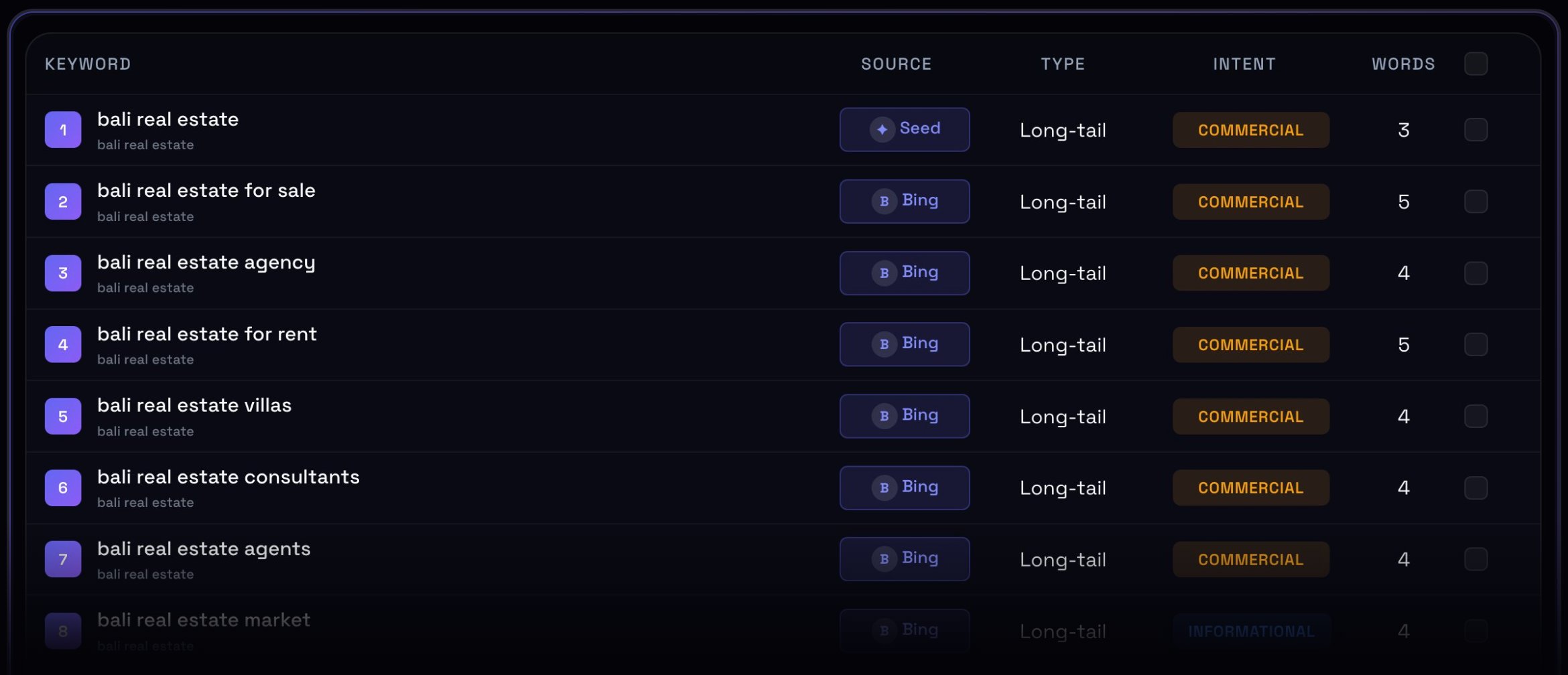
Some sources are easy to query. Google Suggest and Bing have stable, well-documented endpoints. Some are harder. TikTok's API gets blocked regularly, Reddit changed its access policy in 2023, Perplexity's API is rate-limited. We deal with that explicitly — if a source can't be reached, the tool says so rather than silently substituting Google data and pretending it's TikTok data.
That last point matters. A few competing tools claim "TikTok keywords" or "Reddit keywords" but show you Google Suggest results filtered for terms that might appear on those platforms. That's not what we do. If TikTok is unreachable, the result for TikTok is empty, with a note explaining why. The data you see for each source actually came from that source.
The honest tradeoff: search volume
Here's the part nobody else wants to say out loud. Search volume — the monthly number next to each keyword — exists only for Google. Google publishes it through Keyword Planner. Bing has limited equivalents. Everyone else (TikTok, Amazon, Reddit, Etsy, YouTube, Perplexity) does not expose query volumes at all.
Tools that show "search volume" for a TikTok keyword are estimating an estimate. They're inferring activity from social signals, video counts, hashtag frequency — anything that proxies for demand — and printing a number that looks authoritative. It isn't.
We made a deliberate choice not to fake it. For non-Google sources you get the keyword and the source it came from. No invented volume. The reasoning is straightforward: a number that looks precise but isn't precise is worse than no number at all, because people make decisions based on it. Better to know you're looking at a real query that real users typed than to chase a fabricated demand score.
What you get instead of fake volumes: intent classification (informational, commercial, transactional, navigational), which actually transfers between platforms — Etsy and Amazon queries map to commercial intent the same way Google ones do. Plus synonym groupings, so you don't scroll through 800 near-duplicates of the same long-tail.
When to use which source
There's no universal answer here. After running keyword research across maybe several hundred projects, what I've ended up with is more rules of thumb than a framework.
If you're selling physical products, your core sources are Google plus Amazon plus eBay. That covers most of the actual buying intent. Etsy only matters if you're in craft, gift, vintage, or handmade — outside that space, ignore it. TikTok comes in if your buyers are under 35; otherwise it's mostly going to be noise for the project.
For B2B SaaS the mix is different. Google still matters, but I'd say at least half of actual buying research happens on Reddit — engineers and ops people genuinely use it that way. YouTube fills in comparison reviews. Skip TikTok unless your customers are creators or marketers themselves.
Local services stay mostly Google-driven. The one addition worth making is YouTube for problem-stage queries — people search "how to unclog a drain" before they ever search "plumber near me", and capturing that earlier touchpoint is often easier than competing for the local pack.
Content sites and publishers benefit from the widest mix: Google plus Reddit plus YouTube plus Perplexity plus PAA. That combination catches both the traditional informational queries and the AI-search shift, and it's the only setup I've found that gives you a fair picture of where readers are coming from.
For niche craft or DIY work, Etsy is the primary source full stop, with Google second. Pinterest queries would be valuable here too — fair disclosure, we don't currently parse Pinterest, but if you can pull that data some other way, do it.
The wrong move is running all 14 sources every time. You'll get duplication and noise. Three or four sources, picked to match the buyer, is the right shape.
What to do in the next hour
If you've made it this far and currently use a single keyword tool: take one of your active projects, pick three seed keywords, and run them through two non-Google sources. Reddit and Amazon if you're selling anything physical. Reddit and YouTube if you're not.
You'll find at least one query phrasing you'd never have written down yourself. Probably more. Some of those will be queries you should be ranking for and aren't, because they didn't exist in your keyword database.
That's the gap. It's there whether or not you use our tool, and it's been growing for three years. Closing it is the work.